

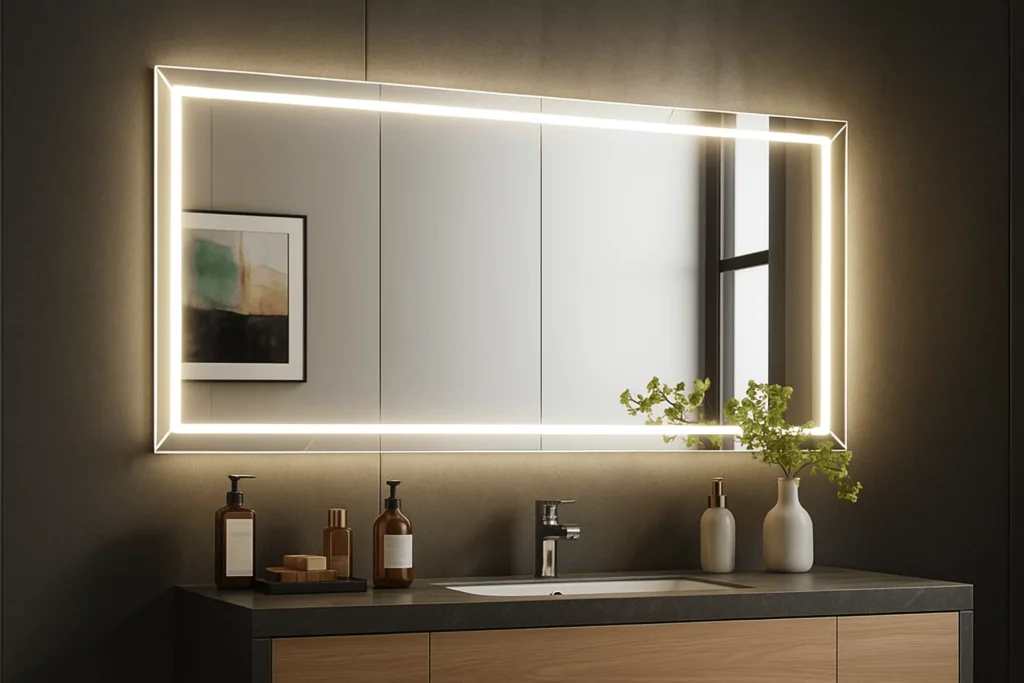
A mirror is the one fixture in the house you look at every day with your face six inches from it. That makes it an odd product to buy on a thumbnail. LED bathroom mirrors at similar prices can differ enormously in light quality, glass durability, and how they behave when your hands are wet, and none of that shows in the listing photo.
The category has also expanded fast. What used to be a single frameless rectangle with a glowing border now includes backlit panels, front-lit strips, round and arched shapes, smart displays, and dimmable color-changing versions. Sorting the meaningful differences from the marketing takes about ten minutes if you know where to look.
Start with light quality, not brightness
Lumens is the number on every listing and the least useful one for a mirror. Three others determine whether you actually like the result.
- CRI (color rendering index): measures how accurately the light reproduces color against natural daylight. Below 80 distorts skin tone and makes color matching unreliable. Look for CRI 90 or higher, and treat a missing CRI figure as a signal in itself.
- Color temperature: around 3000K reads warm and residential, 4000K is neutral, and 5000K to 6000K is cool and daylight-like. Models with an adjustable 3000K to 6000K range let different people in the house get what they need at different hours.
- Diffusion: light should emerge evenly through a frosted band, not as visible dots. Individual diodes create hot spots and glare, and once you notice them reflected in the glass you cannot unnotice them.
Backlit, front-lit, or both
This choice affects how the mirror looks in the room and how well it lights your face. Those are not the same thing.
- Backlit: the LED strip faces the wall, creating a halo around the mirror edge. It looks excellent in photos and produces soft ambient light, but it puts relatively little illumination on you.
- Front-lit: the light faces into the room through a frosted band on the glass surface. Less dramatic, considerably more useful for shaving, skincare, or makeup.
- Side-lit vertical bands: light both sides of the face evenly and minimize shadows, which is why theater dressing rooms adopted the layout a century ago.
- Combination models: offer both, usually with separate controls, and solve the trade-off at slightly higher cost.
If the mirror is the only light source above the sink, prioritize front or side lighting. If you already have good vanity lighting, a backlit mirror is a reasonable aesthetic choice.
Glass, coating, and shape
The lighting gets the attention, but the glass decides how the mirror ages in a room that runs humid twice a day.
- Backing: copper-free, moisture-resistant silvering resists the black edge spotting that appears on cheaper mirrors within a few years
- Anti-fog: a heating element behind the glass keeps a section clear while the shower runs, and it is the feature people underestimate most
- Edge finish: flat polished edges read modern, beveled edges read traditional, and frameless designs are the easiest to keep clean
- Shape: rectangles suit standard vanities, while round and arched mirrors soften a room full of hard lines. Make sure a round mirror is still wide enough to be practical for two people.
- Thickness: heavier glass sits flatter against the wall and distorts less, which matters more than the spec sheet suggests
Controls, power, and mounting
These practical details never appear in the styled photograph and shape daily use more than the finish does.
- Dimming and memory: full brightness at 6 a.m. in a dark bathroom is unpleasant. Check that the mirror dims, and check whether it remembers your last setting or resets each time.
- Control type: touch sensors are clean but can be temperamental with wet fingers. Some models work off a standard wall switch, which suits people who want a physical control.
- Certification: anything electrical in a wet room should carry ETL or UL listing. If the listing does not name a certification body, that is a real gap.
- Wiring: hardwired installation looks cleanest but needs a junction box in the wall. Plug-in models need an outlet within cord reach, and a visible cord undercuts the effect.
- Mounting: confirm the weight and the hardware supplied. No-drill mounting options exist on select models, which helps if you are working with tile you would rather not cut into.
A short pre-purchase checklist
Run through this once and most of the common regrets disappear.
- Measure the vanity width and keep the mirror narrower than it, usually a few inches inside each edge
- Leave roughly 4 to 8 inches between the vanity top and the bottom of the mirror
- Set the mirror center near the eye level of whoever uses the room most
- Decide hardwired or plug-in before ordering, not after the mirror arrives
- Read the installation documentation up front, especially the mounting and weight requirements
- Check the return window, since a mirror is awkward and expensive to send back
Documentation and real support matter here more than a small price difference, because a mirror is heavy, fragile, and mounted permanently. Retailers such as Allsumhome that publish full lighting specifications and offer engineer support by phone make the decision far less speculative, and a well-chosen mirror will do its job quietly every morning without ever asking for your attention.
