

CPR Certification Online: What the Training Actually Teaches, and Why Each Detail Matters
Cardiac arrest outside a hospital setting is survivable, but the odds fall sharply with every minute that passes without intervention. That reality is what makes cpr certification online more than an administrative box to check. Bystander CPR can double or even triple a person’s chance of survival, yet it is still not performed in a substantial share of cases. The gap is rarely indifference. It is hesitation, born of not knowing exactly what to do. Certification training exists to close that gap, and it does so by building a small number of specific competencies.
Recognizing Cardiac Arrest
The first skill is identification, and it is the one people most often get wrong.
A person in cardiac arrest is unresponsive and not breathing normally. The complication is that many arrest victims produce agonal gasps, which are irregular, gasping, sometimes noisy respiratory efforts that can continue for several minutes after the heart stops. Untrained bystanders frequently interpret these as breathing and delay compressions as a result.
Training teaches responders to treat agonal gasping as a sign of arrest rather than a sign of life, to limit assessment to roughly ten seconds, and to begin compressions when there is any doubt. The risk of starting compressions on someone who does not need them is far lower than the cost of delay when they do.
Compressions Performed Correctly
Chest compressions are conceptually simple and mechanically demanding, which is why the specifics are drilled.
For an adult, compressions are delivered at the center of the chest, to a depth of at least two inches but no more than two and a half, at a rate of 100 to 120 per minute. Between each compression, the chest must recoil fully. Incomplete recoil is a common error and it directly reduces the blood returning to the heart, which reduces what the next compression can circulate.
Interruptions matter as much as technique. Every pause allows perfusion pressure to drop, and rebuilding it takes several compressions. Training emphasizes keeping pauses under ten seconds, whether for ventilations, AED analysis, or a change of rescuer. When more than one trained responder is present, rotating roughly every two minutes preserves compression quality, because fatigue degrades depth long before the rescuer notices.
Using an AED Without Delay
Defibrillation is the definitive treatment for the shockable rhythms that cause most sudden cardiac arrest, and time is the variable that determines whether it works.
Certification covers pad placement, the importance of a dry chest, clearing the patient before analysis and shock delivery, and resuming compressions immediately after a shock rather than pausing to check for results. It also covers the situations that trip people up: implanted devices, medication patches, water, and pediatric pad settings.
The practical message is that an AED should be retrieved and applied as soon as one is available, without waiting for professional responders and without hesitation about whether the situation qualifies.
Airway Obstruction and the Transition to CPR
Choking response is taught alongside CPR because the two connect. A conscious choking adult receives abdominal thrusts. If that person becomes unresponsive, the responder lowers them to a firm surface and begins compressions, checking the mouth for a visible obstruction before each set of rescue breaths and removing anything visible without ever performing a blind sweep. Knowing where that handoff occurs prevents the freeze that commonly happens at the moment of collapse.
Pediatric Differences
Adult protocols do not transfer directly to children and infants, and this matters enormously for parents, childcare staff, educators, and coaches.
Pediatric arrest is far more often respiratory in origin than cardiac, which means ventilations carry greater weight in the response. Compression depth is scaled to about one third of the chest’s depth, and infant compressions use a two finger or two thumb encircling technique rather than the heel of the hand. Certification courses that treat pediatric content as a full module rather than a footnote are the ones worth choosing.
Why the Online Format Supports Retention
CPR skills decay measurably within months of training, which is the strongest argument for a format that allows review. Well-built online courses, developed in line with American Health Association (AHA guidelines compliant) standards, let learners return to a specific module the week before a shift, a season, or a family trip, rather than relying on a single session absorbed a year earlier.
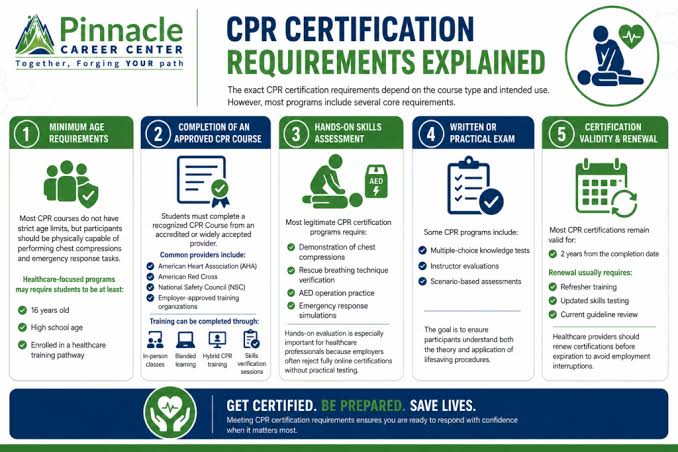
Certification runs on a standard two year renewal cycle, but the useful practice is shorter and more frequent: a brief refresher every few months on the sections you would most likely need.
Competence in an emergency comes from knowing the sequence well enough that you do not have to think about it. To review course options across CPR, BLS, and first aid, and choose a program that fits your role and schedule, visit Simple CPR and get certified before the situation arrives that requires it.
