

Art Deco Engagement Rings: What Collectors and Couples Should Know Before Buying
Few jewelry styles have held their appeal as consistently as the geometric designs of the 1920s and early 1930s. A century after they were made, art deco engagement rings remain among the most requested pieces in the antique market, sought after by couples who want something with genuine history and by collectors who recognize the period as a high point in American and European craftsmanship. Understanding what defines the era, and how to evaluate an individual piece, makes the difference between an informed purchase and an expensive guess.
The Design Language of the Period
The Art Deco movement took its name from the 1925 Exposition Internationale des Arts Décoratifs in Paris, though the aesthetic had been forming for several years before that. In jewelry, it marked a decisive break from the soft, flowing lines of Art Nouveau and the lace-like delicacy of the Edwardian period. Designers turned toward symmetry, bold geometry, and strong contrast.
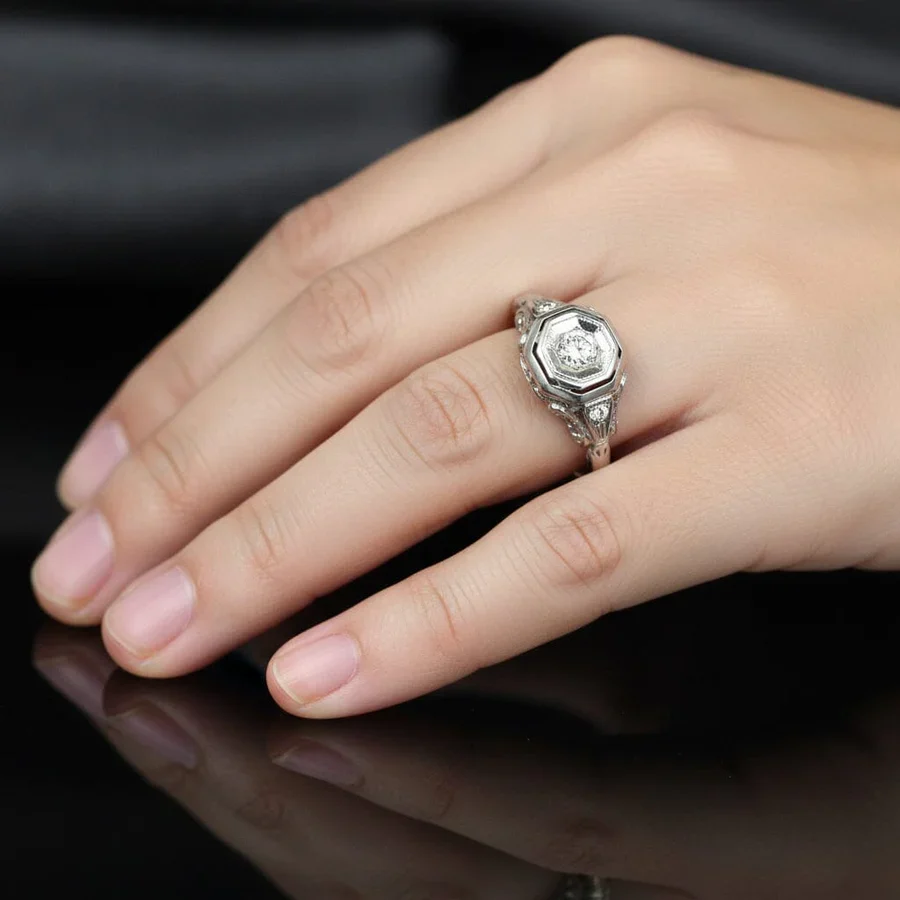
The vocabulary of the period is distinctive. Stepped shoulders, hexagonal and octagonal mountings, chevrons, and rectilinear panels replaced the garlands and bows of earlier decades. Filigree work became more architectural than ornamental. Milgrain beading edged the metalwork with a fine, textured line that softened otherwise severe forms. Calibré-cut sapphires, emeralds, and onyx were fitted flush against diamonds to create sharp color blocking, a technique that required considerable skill to execute cleanly.
This was also a period shaped by new technology. Improvements in platinum working allowed jewelers to build settings that were both strong and remarkably fine, holding stones in place with far less visible metal than gold could manage. The result is a signature Art Deco effect: white metal that recedes visually, letting the stones do the work.
Reading the Stones
Diamond cutting in the 1920s was in transition, and the cuts found in period rings are one of the clearest authentication signals available to a buyer.
Old European cuts, with their small tables, high crowns, and open culets, dominate the earlier part of the era. They produce a warmer, more luminous flicker under candlelight or incandescent bulbs than modern brilliants, which were engineered for maximum white light return. Old Mine cuts, squarer in outline with rounded corners, appear frequently in pieces made from recut or reused stones. Transitional cuts, which bridge the old European and the modern round brilliant, show up increasingly toward the 1930s.
Emerald cuts and Asscher cuts also came into their own during this period, their step facets suiting the era’s preference for clean lines. Baguettes were widely used as side stones and shoulder accents. A ring described as Art Deco but set with a modern round brilliant or a princess cut has almost certainly been altered or is a later reproduction.
Distinguishing Original from Reproduction
Reproduction Art Deco rings are common and are not inherently a problem, provided they are sold as what they are. The concern is when a modern piece is presented as period.
Several things are worth examining. Original platinum work from the era was typically hand fabricated or die struck, and under magnification the metal often shows tool marks, slight asymmetries, and evidence of hand engraving. Cast reproductions tend to look uniform in a way that period work does not. Hallmarks and maker’s marks, where present, offer useful evidence, as do the wear patterns you would expect on a piece that has been worn for decades. Prong tips soften, shanks thin at the bottom, and engraving wears shallow.
None of this is conclusive on its own, which is why provenance and a written appraisal from a qualified specialist matter. Reputable estate dealers document period attribution as a matter of course rather than treating it as an optional extra.
Practical Points Before You Commit
A century-old ring carries practical considerations a new one does not. Filigree galleries and finely worked shanks can limit how far a ring may be safely sized, so it is worth asking about resizing tolerance before purchase. Older prongs may need retipping, which is routine maintenance rather than a defect. Original stones will frequently carry inclusions or color grades that a modern buyer might not choose, but which are entirely consistent with the era and are part of what makes the piece authentic.
There is also the matter of value. Genuine period pieces are finite in supply, which supports their long-term desirability in a way that mass-produced contemporary jewelry rarely matches. For buyers weighing an heirloom purchase against a new ring at a similar price, that distinction is worth considering.
Art Deco design has outlasted nearly every trend that followed it, and the rings from that era continue to attract buyers who want a piece with real provenance and lasting presence. If you are ready to see what genuine period craftsmanship looks like in person, explore the curated antique and vintage collection at Gesner Estate Jewelry, where every piece is assessed for quality and authenticity, and visit their Tampa showroom or browse online to find the ring that fits your story.
